

1. Executive Summary & Technical Paradigm in Transportation Magnetics
The global transportation ecosystem is undergoing a unprecedented paradigm shift. Driven by aggressive decarbonization mandates, the rapid advancement of Wide-Bandgap (WBG) semiconductors like Silicon Carbide (SiC) and Gallium Nitride (GaN), and the relentless push toward autonomous heavy machinery, the demand for high-density, thermally optimized Transportation Industry Magnetics has surged globally.
Modern transportation systems—ranging from passenger Electric Vehicles (EVs) and high-speed rail traction inverters to marine power distribution systems and eVTOL (electric Vertical Take-Off and Landing) aircraft—operate under extreme environmental and electrical conditions. Magnetic components within these applications are subjected to harsh ambient temperature swings (-40°C to +175°C), continuous mechanical shock and vibration, high common-mode dv/dt noise from fast-switching inverters, and strict volumetric weight constraints.
To survive and thrive in this rigorous ecosystem, procurement directors and engineering teams can no longer rely on commercial off-the-shelf (COTS) standard parts. Sourcing optimal magnetics requires a deep understanding of electromagnetic design trade-offs, advanced core material loss behavior, thermal management strategies, and international regulatory standards such as AEC-Q200, EN 50155, UL 94-V0, and IEC 60601/61800.
Information Gain Insight: The High-Frequency & Thermal Challenge
While traditional silicon-based IGBT inverters operated at switching frequencies between 5 kHz and 20 kHz, modern SiC/GaN powertrains switch at 100 kHz to over 500 kHz. While higher frequencies reduce magnetics volume, they drastically amplify skin depth effects, proximity losses, and core eddy currents. Sourcing successful transportation magnetics demands Litz wire topologies, planar core structures, and customized gap configurations engineered specifically to minimize AC resistance ($R_{ac}$) at operating temperatures.
2. Recommended Magnetic Components for Transportation Applications
Triad Magnetics designs and manufactures an extensive range of magnetic components tailored to meet the electrical isolation, energy storage, and noise filtration demands of modern mobility systems. Below are key product categories recommended for integration into transportation sub-systems:
Featured Core Products for Mobility & Powertrain Systems
Selected high-reliability components engineered for severe operating environments, fast switching frequencies, and high voltage isolation.
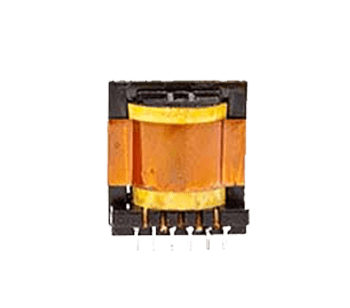
High-Frequency Power Transformers
Designed for On-Board Chargers (OBC), DC-DC converters, and auxiliary power units (APU). Optimized for SiC/GaN topologies with creepage/clearance distance meeting IEC 60664-1 safety standards.
Learn Specifications →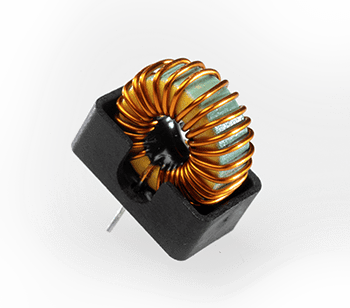
Power Inductors & Common-Mode Chokes
Heavy-gauge copper chokes engineered for EMI filtering in rail traction drives, EV fast-charging stations, and heavy commercial vehicles. Superior saturation currents and low DC resistance.
Learn Specifications →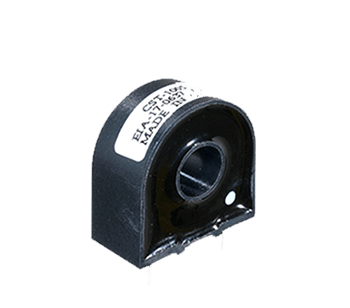
Precision Current Sense Transformers
High-accuracy magnetic current sensors vital for real-time Battery Management Systems (BMS), inverter phase monitoring, and fast fault-protection circuitry.
Learn Specifications →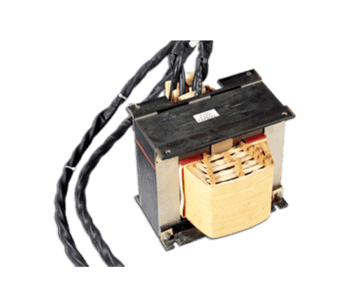
Fully Encapsulated Custom Magnetics
Potting-encapsulated custom transformers engineered to withstand extreme shock, vibration (MIL-STD-202/EN 50155), water submersion, and salt spray in heavy equipment and marine craft.
Learn Specifications →Application Matrix: Matching Magnetics to Transportation Sub-systems
Different transportation sectors present vastly distinct engineering constraints. The table below outlines recommended component types based on specific subsystem operational requirements:
| Transportation Sub-system | Primary Technical Challenge | Recommended Magnetic Solution | Key Regulatory / Engineering Benchmark |
|---|---|---|---|
| EV On-Board Charger (OBC) & DC-DC | High power density, thermal dissipation, low profile | Planar High-Frequency Transformers & Resonant Chokes | AEC-Q200, UL 94-V0, ISO 26262 ASIL-D |
| Railway Traction Inverters & Controls | Vibration shock, high voltage transients, continuous duty | Encapsulated Toroidal Transformers & High-Current PFC Chokes | EN 50155, EN 45545-2 (Fire & Smoke) |
| EVSE Fast Charging Stations | Continuous high-power throughput (150kW–400kW), grid noise | Water-Cooled High Power Inductors & Isolation Transformers | UL 2202, IEC 61851-23, IEEE 519 |
| Aerospace & Defense Avionics | Weight minimization, extreme pressure/altitude variation | Lightweight Custom Foil Winding & High-Temp Ferrite Magnetics | RTCA/DO-160G, MIL-PRF-27 |
| Commercial Fleet Battery Management (BMS) | Galvanic isolation, high-precision current feedback | Custom Current Sense Transformers (Up to 4000V Isolation) | IEC 60664-1 Pollution Degree 3 |
3. Technology & Engineering Development Trends in Transportation Magnetics
Designing magnetics for 21st-century mobility is no longer just about copper turns and silicon steel laminations. The rapid convergence of material science, thermal physics, and semiconductor technology is pushing magnetic engineering to absolute physical boundaries. Below are the key technological trends shaping the sector:
A. Wide Bandgap (SiC/GaN) Compatibility and High Switching Frequencies
Silicon Carbide (SiC) MOSFETs enable switching speeds over 100 kHz at voltages exceeding 800V. Gallium Nitride (GaN) devices operate reliably in the MHz regime. At these frequencies, classic low-frequency core materials (such as standard electrical silicon steel) exhibit catastrophic hysteresis losses ($P_h \propto f$) and eddy current losses ($P_e \propto f^2$).
Consequently, state-of-the-art transportation magnetics increasingly incorporate advanced nanocrystalline cores, amorphous alloys, and high-saturation MnZn/NiZn soft ferrites. Nanocrystalline materials offer exceptionally high permeability ($\mu_r > 80,000$) combined with high saturation flux density ($B_s \approx 1.2 \text{ Tesla}$), allowing engineers to shrink common-mode EMI filter footprints by up to 60% compared to conventional ferrite solutions.
B. Planar Magnetics and Integrated Core Topologies
In height-constrained environments—such as under-floor battery trays in passenger EVs or low-profile avionics racks—traditional wire-wound bobbin transformers are being superseded by Planar Transformers. Planar designs replace magnet wire with multilayer Printed Circuit Board (PCB) traces or copper stampings, sandwiched around low-profile E-cores.
- Thermal Performance: Superior surface-area-to-volume ratio enables rapid thermal dissipation into cold plates.
- Repeatability: Automated PCB manufacturing eliminates manual winding variance, guaranteeing consistent leakage inductance ($L_{lk}$) and parasitic capacitance ($C_p$).
- Power Density: Achieves volumetric power densities exceeding $25 \text{ W/cm}^3$.
C. Advanced Thermal Encapsulation & Liquid Cooling Integration
Thermal management is the single largest factor determining magnetic component lifespan. In high-power transportation systems, thermal runaway degrades magnet wire insulation (causing inter-turn shorts) and induces thermal curie-point degradation in magnetic cores. Modern magnetics integrate advanced vacuum-pressure impregnation (VPI) utilizing thermally conductive (up to $3.0 \text{ W/m}\cdot\text{K}$) potting compounds (epoxies, polyurethanes, or structural silicones).
Furthermore, mega-watt level transportation magnetics—such as those found in marine propulsion drives or locomotive traction—are now engineered with integrated liquid-cooling channels, direct cold-plate mounting flanges, or hollow copper conductors designed for internal coolant circulation.

Figure 1: Heavy-duty transportation & industrial vehicles require ruggedized magnetic enclosures capable of operating continuously under severe vibration, thermal stress, and dusty outdoor exposure.
4. Global Sourcing & Procurement Trends in Transportation Magnetics (2025–2030)
For global Tier-1 automotive suppliers, rail OEM integrators, and industrial procurement executives, navigating the magnetic component supply chain has become increasingly strategic. Beyond technical performance, procurement strategies are heavily influenced by geopolitical realities, total cost of ownership (TCO), and sustainability mandates.
1. Supply Chain Resilience: The "Nearshoring + Dual-Footprint" Mandate
The supply chain disruptions of recent years demonstrated the fatal risk of single-source, single-region manufacturing. Modern procurement directors require magnetics partners with multi-regional manufacturing redundancy. Leading suppliers maintain localized engineering, prototyping, and fast-turn production in North America alongside cost-competitive high-volume automated manufacturing in Southeast Asia (such as the Philippines).
This dual-footprint model allows OEM buyers to transition seamlessly from rapid NPI (New Product Introduction) prototypes to high-volume commercial production while mitigating tariff risks, regional port congestions, and geopolitical friction.
2. Design-for-Manufacturability (DFM) & Total Cost Optimization
While low initial unit cost was historically the dominant metric in component purchasing, modern procurement intent focuses heavily on **Total Cost of Ownership (TCO)**. Non-conforming magnetic components that fail in the field can trigger multi-million dollar automotive recalls or catastrophic transit delays.
Leading buyers engage component manufacturers early in the DFM phase to eliminate costly over-engineering. Key DFM cost reduction levers include:
- Standardizing on catalog core geometries (e.g., E, PQ, ETD, EQ) rather than expensive custom tooling where possible.
- Optimizing winding insulation classes (e.g., Class F 155°C vs. Class H 180°C) to match true system lifespans.
- Automating termination and pin-insertion processes to streamline automated SMT or Through-Hole assembly on the customer's PCB line.
3. Rigorous ESG, RoHS, REACH, and Conflict Minerals Traceability
Global transportation manufacturers are bound by stringent environmental regulations. Procurement departments must ensure full material transparency across every upstream magnetics component. Key compliance benchmarks include:
- RoHS & REACH Compliance: Complete elimination of hazardous substances, heavy metals, and restricted plasticizers in wire coatings and bobbin plastics.
- Conflict-Free Material Sourcing: Full audits verifying that tin, tantalum, tungsten, and gold (3TG) used in terminal plating are ethically sourced.
- Carbon Footprint Accounting: Upstream transparency regarding energy intensity during core sintering and copper wire drawing.
5. The Triad Magnetics Advantage: Why Global OEMs Partner With Us
For over 75 years, Triad Magnetics has been a trusted global leader in precision electromagnetic design and custom magnetics manufacturing. When it comes to transportation industry magnetics, Triad offers an unexcelled combination of engineering expertise, manufacturing capability, and quality assurance.
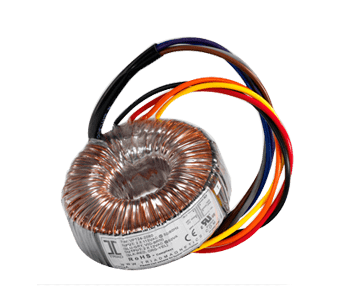
Over 75 Years of Engineering Heritage: Founded in 1946 in Southern California, Triad Magnetics helped power early industrial advancements and space exploration. Today, our engineering teams continue to solve the toughest high-frequency power electronic challenges facing the transport industry.
ISO 9001:2015 Certified Quality Systems: Quality is engineered into every component. Our state-of-the-art testing facilities perform 100% electrical testing, automated optical inspection (AOI), hi-pot isolation verification (up to 5kV+), and thermal shock cycling before shipment.
Global Manufacturing Footprint: Triad maintains headquarters, custom engineering labs, and warehousing in Perris, California, backed by ISO-certified manufacturing facilities in the Philippines. This gives global procurement teams the agility of domestic US support combined with global cost competitiveness.
Extensive Standard Catalog & 100% Customization: With over 5,000 standard part numbers in stock, we offer rapid off-the-shelf samples for prototyping. For unique mechanical envelope or voltage requirements, our application engineers deliver full custom design turnaround from prototype to mass production.
6. Frequently Asked Questions (FAQ) for Transportation Magnetics Sourcing
Based on frequent queries submitted by global procurement teams, AI intent engines, and OEM design engineers, we have compiled detailed answers to essential technical and sourcing questions:
- Vibration & Mechanical Shock: Must pass strict mechanical stress testing (e.g., AEC-Q200 Grade 0 or EN 50155) to survive continuous highway vibration or rail track shock.
- Thermal Envelope: Designed for extended ambient ranges (typically -40°C to +125°C or +150°C), utilizing Class H (180°C) or Class R (200°C) insulation systems.
- High Dielectric Isolation: Requires extended creepage and clearance distances to withstand severe voltage surges and high common-mode noise generated by fast-switching inverter drives.
- Material Traceability: Strict Lot Traceability, PPAP (Production Part Approval Process) Level 3 documentation, and zero-defect quality control.
- Material Selection: Utilizing high-thermal-conductivity potting resins (silicone, polyurethane, or epoxy) that transfer heat directly from windings to the aluminum enclosure.
- Low-Loss Winding Topologies: Utilizing Litz wire, copper foil windings, or planar PCB traces to mitigate AC skin and proximity resistance losses at high operating frequencies.
- Custom Core Gapping: Distributing core gaps across multiple segments to reduce fringing flux losses that cause localized hot spots in copper windings.
- Direct Cold-Plate Mounting: Designing custom mechanical frames that maximize conductive contact with customer liquid-cooled aluminum cold plates.
Litz wire consists of multiple individually insulated magnet wire strands twisted together in specific patterns. This equalizes the proportion of magnetic flux experienced by each strand, forcing current to distribute uniformly across the entire conductor cross-section, reducing AC losses by up to 70%.