ISO 9001:2015Dual US & Global Production Facilities
100%Custom Parameter Tailoring
Executive Engineering Overview
1. Why Custom Power Transformers Drive Modern OEM Product Differentiation
In modern electronic systems design, power conversion efficiency, thermal management, physical form factor, and strict electromagnetic compatibility (EMC) are no longer secondary considerations—they are the primary determinants of product success. While standard catalog magnetic components offer speed to market for basic prototypes, off-the-shelf units almost universally introduce engineering compromises. OEMs often face excess core losses, unoptimized winding copper losses, undesirable physical dimensions, or inadequate creepage and clearance distances that jeopardize regulatory approval.
Custom Power Transformers solve these challenges at the architectural level. By engineering the magnetic circuit specifically around an application’s operational duty cycle, switching frequency, input voltage range, and ambient temperature profile, custom transformers maximize energy transfer density while minimizing total harmonic distortion (THD) and stray magnetic flux leakage.
Semantic Search & AI Intent Insight: Standard vs. Custom Magnetics
Global procurement teams asking AI engines "When should an OEM switch from catalog transformers to custom power transformers?" frequently receive generic advice. The engineering reality comes down to four quantitative thresholds: 1) Thermal Limit Exceedance in enclosed chassis; 2) Strict Leakage Current Limits (such as IEC 60601-1 2MOPP medical requirements); 3) Form Factor Constraints requiring planar or low-profile toroidal geometries; and 4) Total Cost of Ownership (TCO) Optimization at high-volume production scale.
When evaluating custom magnetics design, engineering teams must evaluate key trade-offs between core material selection, winding topologies, insulation system classes, and thermal dissipation paths. The matrix below outlines how tailored custom power transformer engineering compares directly against standard off-the-shelf alternatives across critical operational parameters:
Engineering Vector
Standard Off-The-Shelf Transformer
Triad Custom Power Transformer
OEM System Advantage
Core Material & Loss Optimization
Fixed M6 silicon steel or basic ferrite; non-optimized core losses at specific frequencies.
High-grade silicon steel laminations, nanocrystalline, or custom powder/ferrite formulations tailored to operating frequency.
Up to 25% reduction in no-load and core losses; lower ambient thermal rise.
Winding & Copper Utilization
Standard round copper wire; fixed primary/secondary turns ratio; sub-optimal fill factor.
Litz wire, foil windings, or multi-strand parallel magnet wire designed for skin effect & proximity effect mitigation.
Minimal I²R copper losses at elevated operating temperatures and high switching harmonics.
Dielectric & Creepage Spacing
Standard 1.5kV – 2.5kV AC isolation; fixed creepage distance (4mm - 6mm).
Engineered triple-insulated wire (TIW), reinforced split-bobbins, or Faraday shielding offering up to 4.5kV+ AC isolation.
Guaranteed compliance with IEC 60601-1 (Medical 2MOPP) and UL 5085-2 heavy industrial standards.
Thermal Insulation Class
Class A (105°C) or Class B (130°C) default rating.
Class F (155°C), Class H (180°C), or Class N (200°C) custom insulation systems with VPI treatment.
Extended mean time between failures (MTBF) under harsh continuous ambient temperatures.
Chassis Fit & Mounting
Rigid standard EI or UI lamination footprints; fixed lead/pin exit angles.
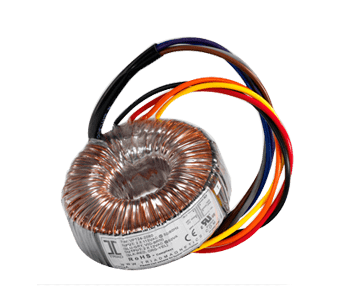
Toroidal, planar, low-profile PC-mount, or custom bracket assemblies with flexible flying leads or custom pinouts.
Eliminates internal mechanical redesigns and optimizes enclosure packing density.
Product Portfolio Showcase
2. Recommended Custom Power Transformer Categories & Product Solutions
Triad Magnetics engineers and manufactures a broad range of magnetic topologies tailored for demanding power conversion environments. Below are our key specialized product lines widely specified by Fortune 500 OEMs, defense contractors, renewable energy innovators, and medical equipment manufacturers.
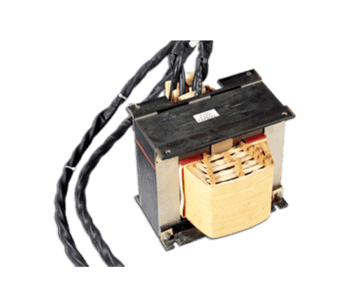
Custom Industrial Laminated Power Transformers
Precision-engineered 50Hz/60Hz and 400Hz power transformers utilizing grain-oriented silicon steel laminations. Features split-bobbin construction to ensure high isolation and low capacitive coupling between primary and secondary circuits.
Power Rating: 1 VA to 10 kVA+
Isolation: Up to 4,000V RMS
Thermal Ratings: Class B (130°C) to Class H (180°C)
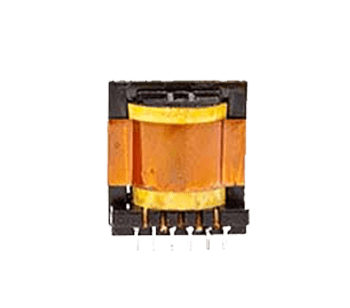
Designed specifically for switch-mode power supplies (SMPS), flyback, push-pull, half-bridge, and full-bridge topologies operating from 20 kHz to over 1 MHz. Incorporates planar cores, EFD, ETD, PQ, and RM ferrite geometries.
Built to stringent IEC 60601-1 3rd/4th Edition medical safety standards. Engineered with dual electrostatic Faraday shields to reduce earth leakage currents to sub-microamp levels, ensuring patient safety in Means of Patient Protection (2MOPP) applications.
Leakage Current: < 10 µA typical
Safety Clearance: 8mm Creepage / 5mm Clearance
Dielectric Strength: 4,500V AC Primary to Secondary
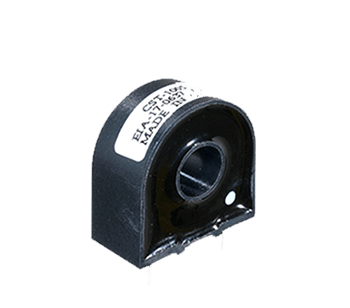
High-accuracy linear current monitoring transformers for power distribution units (PDUs), solar string inverters, EV charging stations, and motor control protection. Optimized for minimum phase angle shift and linear output across wide temperature ranges.
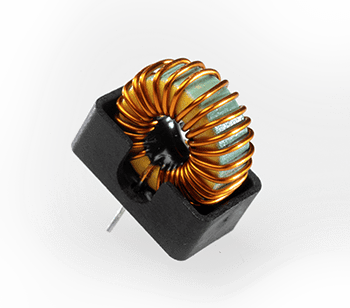
Heavy-duty common-mode and differential-mode power chokes engineered to work alongside custom power transformers. Combines EMI filtering and high DC bias energy storage capability in a single compact footprint.
Ultra-compact planar transformer designs utilizing multilayer PCB windings and low-profile E-core geometries. Designed for space-constrained aerospace, electric vehicle (EV) power modules, and high-density DC-DC converters.
3. Global Development & Procurement Trends in Power Magnetics (2026–2030)
The global power electronics industry is undergoing a massive transformation driven by decarbonization, electrification of transport, the explosive growth of AI data center infrastructure, and renewable energy storage. Procurement and engineering leaders must navigate several emerging technological and supply chain shifts:
A. Adoption of Wide Bandgap (WBG) Semiconductors (GaN & SiC)
Silicon Carbide (SiC) and Gallium Nitride (GaN) power switches allow switching frequencies to move from historical limits of 50–100 kHz into the 500 kHz – 3 MHz regime. This transition drastically reduces the required physical size of magnetic cores. However, higher switching speeds ($dv/dt$) create extreme voltage stress on magnet wire insulation and dramatically increase high-frequency eddy current and proximity losses in transformer windings.
Future-Proofing Custom Designs: Modern custom power transformers increasingly utilize specialized Litz wire construction with multi-strand insulation, planar PCB windings, and advanced nanocrystalline/high-frequency ferrite cores designed specifically to mitigate parasitic capacitance and Skin Effect losses at multi-megahertz harmonics.
B. Strict Efficiency Standards & Eco-Design Directives
Global regulatory bodies—including the U.S. Department of Energy (DOE 2016), European Union ErP Directive, and China GB standards—are establishing lower limits on core loss and standby power consumption. For industrial power equipment, transformer efficiency targets are approaching 99%.
Custom transformer engineering allows OEMs to select amorphous ribbon cores, low-loss electrical steel grades (such as 0.23mm M0H silicon steel), and optimized turns ratios that meet these stringent efficiency thresholds without requiring costly active cooling systems.
C. Smart Grid, EV Infrastructure, and AI Hyperscale Power Demands
The rapid deployment of 800V EV fast-charging networks, bi-directional V2G (Vehicle-to-Grid) power converters, and 100kW+ AI rack power distribution units (PDUs) demands custom transformers capable of handling massive thermal cycles and severe pulse-width modulation (PWM) harmonic pollution. Custom power transformers equipped with embedded RTD temperature sensors, electrostatic shielding, and specialized Class H (180°C) VPI resin systems are becoming the standard specification for high-reliability infrastructure.
Need Technical Guidance for Next-Gen Power Designs?
Consult directly with Triad Magnetics’ senior electromagnetic design engineers to optimize core size, thermal performance, and compliance for your OEM project.
4. The Triad Magnetics Advantage: Built on 75+ Years of Engineering Excellence
Selecting a custom power transformer manufacturing partner is a long-term strategic commitment. A single component failure or compliance delay can disrupt production lines and compromise brand reputation. Founded in 1946, Triad Magnetics brings unparalleled experience, engineering expertise, authoritative compliance, and supply chain trustworthiness (E-E-A-T) to global OEM buyers.
Engineering Mastery & Global Supply Chain Footprint
Triad Magnetics operates dual ISO 9001:2015 certified manufacturing infrastructure with headquarters in Perris, California, USA, and dedicated high-volume production facilities in the Philippines. This strategic dual-footprint guarantees flexible supply chain risk mitigation, short-run rapid prototyping capability, and cost-effective volume manufacturing.
75+ Years of Industry Leadership: Pioneered audio, industrial, and power transformer design since the dawn of modern electronics.
In-House UL Safety Agency Lab: Direct participation in UL Client Test Data Programs to accelerate safety certifications (UL, CSA, TUV, CE).
Comprehensive Custom Customization: Full electrical tailoring—from fractional VA board-level units to multi-kVA heavy industrial enclosures.
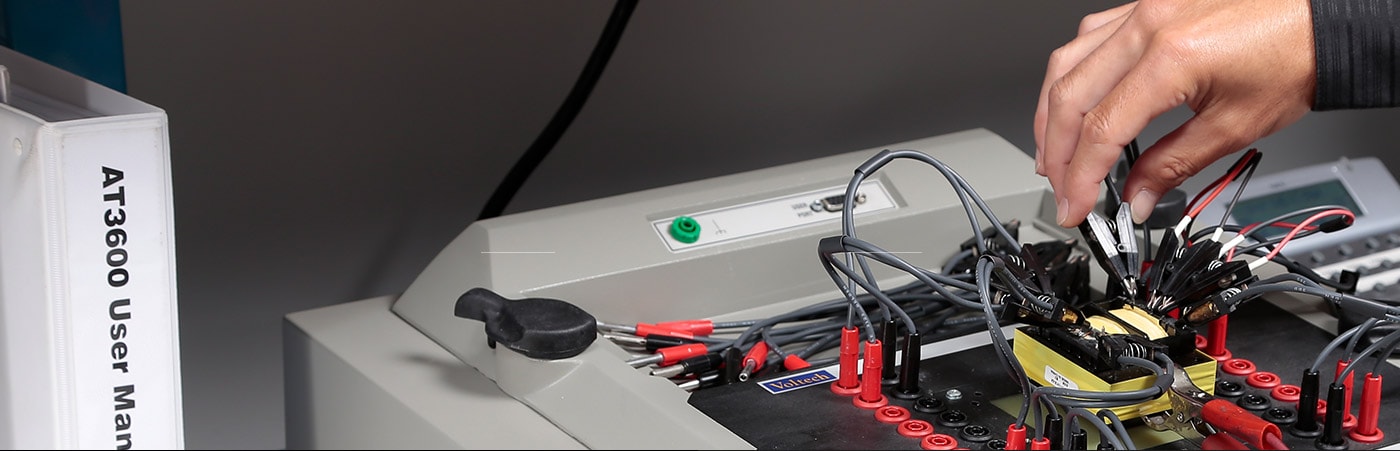
Rigorous Quality Control: 100% automated electrical testing (hi-pot, turns ratio, inductance, DCR, surge testing) on every production batch.
Whether your project requires high-vacuum pressure impregnation (VPI) to eliminate bobbin void noise, custom potted encapsulation for harsh outdoor environments, or custom copper busbar terminals for high-current power distribution, Triad’s engineering team collaborates directly with your design engineers from initial schematic review to final production sign-off.
Frequently Asked Questions
5. Custom Power Transformers: OEM Engineering & Procurement FAQ
Below are technical answers to the most common questions global procurement directors, component engineers, and supply chain managers ask when sourcing custom power transformers:
To initiate an optimal custom magnetics design, our engineering team requires:
Input Voltage & Frequency: Nominal input voltage, line variations (e.g., ±10%), and operating frequency range (e.g., 50Hz, 60Hz, 400Hz, or SMPS switching frequency in kHz).
Secondary Voltages & Full-Load Currents: Specific voltage ratings under full load, current draw per winding, and duty cycle (continuous vs. intermittent).
Isolation Requirements: Required dielectric withstand voltage (Hi-Pot) between primary-to-secondary and primary-to-ground (e.g., 1.5kV AC up to 4.5kV AC).
Thermal & Environmental Limits: Maximum ambient operating temperature, allowable temperature rise (Class B 130°C, Class F 155°C, Class H 180°C), and enclosure airflow conditions.
Mechanical Constraints: Maximum physical footprint (L x W x H), mounting style (PCB pin, chassis feet, toroidal center bolt), and terminal exit requirements.
Core saturation occurs when the magnetic flux density ($B_{max}$) exceeds the core material's saturation limit, causing inductances to drop rapidly and current spikes to escalate thermal dissipation. Triad engineers mitigate saturation through precise core area selection, calculated flux density derating (typically operating at 60–75% of maximum rated saturation density), precision air-gapping in ferrite/powder cores, and using high-grade grain-oriented silicon steel or nanocrystalline materials with high saturation flux thresholds ($B_s > 1.2T$).
UL Class 2 Power Transformers (governed by UL 5085-3) are energy-limited transformers designed to limit output VA and current under overload or short-circuit conditions. They supply secondary circuits restricted to maximum ratings (typically 100 VA or less at 30V AC). Class 2 units eliminate the risk of electrical shock and fire, allowing OEM equipment downstream wiring to bypass costly conduit and heavy wiring enclosures. Standard power transformers (governed by UL 5085-2) do not inherently limit current and require external overcurrent protection devices (fuses or circuit breakers).
Medical power transformers must adhere to stringent Means of Patient Protection (2MOPP) guidelines under IEC 60601-1 3rd/4th Editions. Triad ensures full compliance by implementing reinforced double insulation systems, dual electrostatic Faraday shielding to sink capacitive noise to ground, guaranteeing minimum creepage distances of 8.0 mm and clearance distances of 5.0 mm, and testing every medical unit to withstand dielectric test voltages of 4,000V to 4,500V AC while maintaining total patient leakage currents below microamp limits.
Triad Magnetics offers rapid engineering sample development. Initial custom prototype engineering samples are typically delivered in 2 to 4 weeks depending on component material availability (e.g., custom tooling for bobbins or specialized core shapes). Once prototype testing and customer sign-off are complete, full production lead times range from 6 to 10 weeks, supported by scheduled safety stock programs, blanket ordering, and Kanban supply strategies to support continuous OEM manufacturing lines.
Vacuum Pressure Impregnation (VPI) is a process where the completed transformer assembly is subjected to a deep vacuum to evacuate all air and moisture pockets from within the winding layers, followed by high-pressure injection of high-grade insulating varnish or resin. VPI provides three key benefits: 1) Acoustic Noise Elimination by locking magnet wire coils in place to prevent 60Hz/high-frequency magnetostrictive hum; 2) Superior Thermal Conductivity by replacing air voids with thermal resin; and 3) Moisture & Harsh Chemical Resistance in demanding industrial, marine, or outdoor environments.
Ready to Accelerate Your Custom Power Transformer Project?
Partner with Triad Magnetics’ engineering experts today. Receive rapid engineering design reviews, custom electrical specifications, thermal calculations, and competitive OEM pricing tailored precisely to your application requirements.