

1. Executive Overview: The Critical Imperative of Medical-Grade Magnetics
In modern clinical environments—ranging from surgical operating theaters and intensive care units (ICUs) to diagnostic imaging suites—electrical safety is not merely a design parameter; it is a direct operational prerequisite for patient survival. Electronic medical equipment operates in direct physical or electrical contact with patients whose bodily defenses may be severely compromised by anesthesia, skin prep agents, or invasive catheters. Under these clinical conditions, microampere-level electrical leakage current, which would be entirely harmless in consumer or industrial machinery, can induce fatal cardiac fibrillation or cause catastrophic device malfunctions.
Medical Equipment Transformers serve as the primary defensive barrier between harsh, transient-laden AC power mains and sensitive patient-connected electronic circuits. Unlike commercial or standard industrial power transformers, medical-grade transformers are meticulously engineered to satisfy stringent dielectric withstand voltages, strict creepage and clearance distances, extremely low stray magnetic field radiation, and microscopic earth/patient leakage currents under both Normal Conditions (NC) and Single Fault Conditions (SFC).
Key Takeaway for Procurement & System Architects
Specifying a medical equipment transformer requires a systemic understanding of IEC 60601-1 safety mandates. Over-specifying isolation adds unnecessary mass and cost, while under-specifying can lead to immediate compliance rejection by notified bodies like TÜV, UL, or Intertek during medical device registration.
For over seven decades, Triad Magnetics has engineered high-reliability power components. Our custom and catalog medical equipment transformers are crafted with advanced insulation systems, toroidal electrostatic shielding, and split-bobbin architecture to eliminate electrical noise, contain thermal output, and uphold continuous, uninterrupted operational life in life-critical apparatus.
2. Regulatory Deep Dive: IEC 60601-1 4th Edition, 2 MOPP, & Leakage Suppression
The global standard governing medical electrical equipment safety is IEC 60601-1 (harmonized in North America as ANSI/AAMI ES60601-1 and in Europe as EN 60601-1). Designing medical equipment transformers requires precise compliance with the 3rd and 4th Editions of this standard, which introduced the formal classification of Means of Protection (MOP).
2.1 MOPP vs. MOOP: Understanding the Distinction
IEC 60601-1 categorizes isolation safeguards into two distinct protection designations:
- Means of Patient Protection (MOPP): Mandated for electrical circuits that come into direct physical contact with the patient (e.g., electrocardiographs, surgical lasers, hemodialysis machines, invasive sensors). Isolation must withstand higher test voltages and enforce larger physical creepage/clearance distances to prevent current flow through the patient’s body.
- Means of Operator Protection (MOOP): Designed for equipment used strictly within the patient environment where direct patient contact is excluded (e.g., laboratory centrifuges, hospital IT workstations, diagnostic printers). MOOP criteria mirror standard industrial equipment requirements (IEC 62368-1) more closely.
To achieve 2 MOPP (Two Means of Patient Protection) certification—the gold standard for high-risk medical magnetics—a medical transformer primary-to-secondary insulation system must meet the following strict physical criteria:
- Dielectric Withstand Test Voltage: Minimum 4,000 VAC (or 5,656 VDC) continuous isolation test for 1 minute.
- Minimum Creepage Distance: ≥ 8.0 mm along the insulating surface boundary.
- Minimum Clearance Distance: ≥ 5.0 mm direct air gap between conductive parts.
- Insulation Architecture: Double or reinforced insulation system (UL 1446 Class B 130°C, Class F 155°C, or Class H 180°C).
2.2 Leakage Current Dynamics & Stray Field Containment
Leakage current in medical transformers stems from stray capacitive coupling between the primary winding, secondary winding, and core metal, as well as resistive leakage through insulation media. Standard 60601-1 limits mandate that chassis leakage current for patient care equipment must not exceed 100 μA under Normal Conditions and 500 μA under Single Fault Conditions (and as low as 10 μA for Type CF cardiac-floating direct contact equipment).
To accomplish these ultra-low thresholds, Triad Magnetics integrates specialized construction techniques:
- Electrostatic Faraday Shields: Grounded copper foil shields placed between primary and secondary windings intercept capacitive high-frequency noise and shunt displacement currents harmlessly to earth ground before they reach the patient secondary.
- Concentric & Split-Bobbin Separators: Physical Bobbin walls isolate windings into independent chambers, minimizing parasitic inter-winding capacitance to sub-picofard levels.
- Toroidal Grain-Oriented Core Topologies: Continuous grain-oriented silicon steel cores minimize air gaps, dramatically reducing magnetic stray flux emission (hum and electromagnetic interference) that could distort nearby electroencephalogram (EEG) or magnetic resonance imaging (MRI) signals.
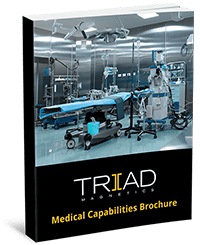
 Figure 1: Precision medical equipment transformers engineered by Triad Magnetics power critical care devices with zero compromise on safety.
3. Transformer Topologies for Medical OEMs: Core Selection & Product Portfolio
Choosing the optimal transformer topology depends heavily on system power density requirements, form factor constraints, acoustic noise limits, and thermal management strategies. Triad Magnetics manufactures four main architectural categories of medical equipment transformers:
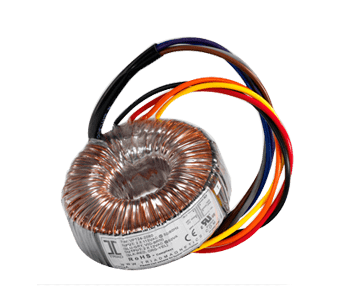
Toroidal Medical Isolation Transformers
Offers up to 50% reduction in physical weight and volume compared to traditional E-I laminations. Features virtually non-existent stray magnetic field emissions, low acoustic hum (< 30 dBA), and continuous low-leakage operation. Ideal for surgical laser systems, patient monitoring carts, and imaging consoles.
View Specs →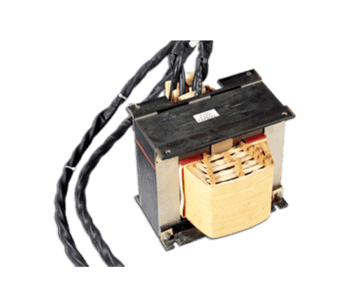
Custom Laminated & Split-Bobbin Transformers
Cost-effective line-frequency power transformers utilizing split-bobbin winding channels that eliminate the need for costly insulation tape wraps. Provides inherent 4,000V isolation between primary and secondary windings with robust physical immunity to high-vibration mobile medical equipment.
View Specs →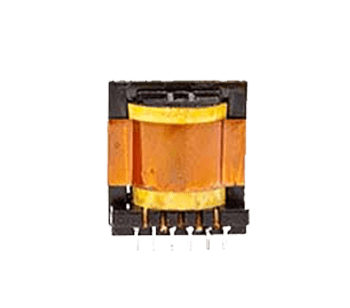
High-Frequency Switch-Mode Medical Transformers
Engineered for ultra-compact switch-mode power supplies (SMPS) operating from 100 kHz to over 1 MHz. Designed with triple-insulated wire (TIW) secondary windings and high-permeability ferrite cores to achieve maximum power density in portable diagnostic gear, ventilator pumps, and hand-held ultrasound devices.
View Specs →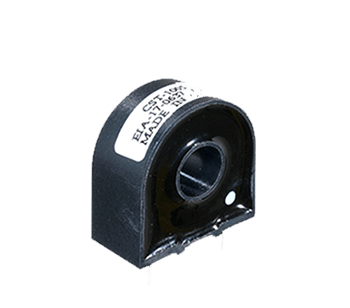
Medical-Grade Current Sense & Signal Isolation Transformers
Sub-miniature current transformers providing high-precision feedback loops, ground fault detection, and digital communications signal isolation. Built to maintain high linearity across broad temperature ranges while preserving 2 MOPP galvanic barriers in telemetry equipment.
View Specs →3.1 Comprehensive Engineering Comparison Matrix
The table below outlines technical tradeoffs across transformer topologies to assist OEM procurement and engineering teams in matching magnetics to specific medical device requirements:
| Architecture Type | Dielectric Rating | Typical Leakage Current | Stray Magnetic Field | Volume / Power Density | Primary Medical Target |
|---|---|---|---|---|---|
| Toroidal Medical Transformer | 4,000 VAC (2 MOPP) | < 10 μA to 50 μA | Ultra-Low (< 5% of E-I) | High (Compact footprint) | MRI, Surgical Lasers, Patient Monitors |
| Split-Bobbin E-I Transformer | 4,000 VAC (2 MOPP) | < 30 μA to 100 μA | Moderate | Standard (Economical) | Hospital Beds, Infusion Pumps, Dialysis |
| High-Frequency SMPS Transformer | 4,000 VAC (2 MOPP) | < 5 μA (Conducted EMI shielded) | Low to Moderate (Ferrite shielded) | Ultra-High (Miniaturized) | Portable Ultrasound, Ventilators, Endoscopes |
| Current Sense Isolation Magnetics | 2,500 - 4,000 VAC | < 2 μA | Negligible | Micro-PCB Mount | Defibrillators, Power Quality Monitors |
Need Custom Engineering for Your Medical Device?
Download our comprehensive product catalog or request a direct design consultation with Triad Magnetics’ Senior Electromagnetic Engineers.
4. Future Trends: Next-Gen Technology & Global Procurement Insights
As healthcare technology shifts rapidly toward localized patient care, artificial intelligence (AI) automated diagnostics, and robotic surgery, the demands placed on medical equipment transformers are evolving. Sourcing managers and biomedical engineers must account for three major macro trends shaping magnetics procurement through 2030:
4.1 Integration with Wide-Bandgap (GaN / SiC) Power Electronics
Medical equipment OEMs are replacing silicon-based MOSFETs with Gallium Nitride (GaN) and Silicon Carbide (SiC) semiconductors in next-generation switch-mode power supplies. Operating at switching frequencies upwards of 500 kHz to 2 MHz, these power stages demand high-frequency medical transformers with advanced Litz-wire windings, planar core geometries, and ultra-low inter-winding capacitance to prevent high-frequency common-mode noise propagation into sensitive patient sensors.
4.2 Smart Thermal Management & Digital Twin Modeling
Enclosed medical systems (such as IPX6 waterproof-sealed operating room carts) restrict natural convective airflow. Modern medical transformers are increasingly embedded with dual thermal protection devices—such as reversible PTC thermistors combined with permanent one-shot thermal cutoffs (TCO) rated for Class F (155°C) or Class H (180°C) operation. Furthermore, leading OEMs now require digital twin FEA (Finite Element Analysis) magnetic and thermal simulations during prototyping to accelerate FDA/CE approval cycles.
4.3 Global Supply Chain Resilience & Dual-Sourcing Strategies
Geopolitical uncertainties, tariff fluctuations, and freight bottlenecks have exposed severe vulnerabilities in single-region supply chains. Global healthcare brands are actively restructuring procurement contracts to demand dual-region manufacturing capabilities. Triad Magnetics addresses this risk directly through fully redundant, ISO 9001:2015 certified manufacturing facilities located in Perris, California (USA) and the Philippines. This strategic footprint guarantees supply chain continuity, optimized duty structures, and localized technical support.
4.4 ESG, RoHS, REACH, and Conflict Mineral Compliance
Sustainability directives in Europe and North America now require medical OEMs to provide comprehensive material traceability. Modern medical transformers must not only meet safety regulations but also enforce total compliance with RoHS 3 (EU 2015/863), REACH EC 1907/2006 (SVHC list), and Dodd-Frank Conflict Minerals reporting. Triad Magnetics provides full material transparency to streamline corporate ESG audits.
5. The Triad Magnetics Advantage: 75+ Years of Engineering Excellence
For more than 75 years, Triad Magnetics has led the electronics industry in magnetics innovation—from powering early broadcast communication equipment in the 1940s to engineering specialized transformers for NASA's lunar missions and today's most advanced robotic surgical systems.
Uncompromising Quality & ISO 9001:2015 Certification
Our global manufacturing facilities strictly adhere to ISO 9001:2015 quality management protocols. Every medical equipment transformer undergoes 100% automated electrical parameter testing, automated turns-ratio validation, and high-voltage dielectric withstand screening prior to shipment.
Get CatalogWhy Leading Healthcare OEMs Partner with Triad Magnetics:
- 5,000+ Standard Catalog Part Numbers: Massive inventory of standard off-the-shelf transformers available through a global distribution network for immediate prototyping.
- Complete Custom Engineering Flexibility: Direct collaboration with experienced engineering teams to create tailored core geometries, mounting brackets, custom pinouts, and specialized thermal enclosures.
- UL recognized Insulation Systems: Pre-approved UL 1446 Class B, F, and H insulation systems accelerate regulatory approval timelines for your end-system medical device.
- Dual-Site World-Class Manufacturing: Seamless transition from USA-based prototype development and pilot runs to high-volume, cost-optimized production in the Philippines.
- DFMEA & Quality Traceability: Full Design Failure Mode and Effects Analysis (DFMEA), Process Capability Studies (Cpk), and batch lot tracking for critical medical device assembly.
6. Frequently Asked Questions (FAQ) for Medical Transformer Procurement
Below are detailed answers to key engineering and procurement queries frequently asked by OEM designers and AI search engines regarding medical equipment transformers: