An authoritative technical breakdown for global procurement managers and electrical design engineers. Discover inherent circuit protection limits, safety compliance standards, recommended component lines, and custom OEM manufacturing capabilities.
Need specialized primary/secondary voltage step-down ratios, custom physical footprints, or split bobbin insulation for medical or industrial Class 2 power supply integration?
In global electrical engineering and commercial control system design, a Class-2 Power Transformer serves as a vital safety isolation barrier designed specifically to supply energy to low-voltage National Electrical Code (NEC) Class 2 circuits. Defined fundamentally by strict power output boundaries—typically delivering an open-circuit voltage of 30 VAC or less and a total apparent power rating not exceeding 100 VA—these transformers mitigate electrical shock and fire hazards at the system level. By design, a Class 2 circuit eliminates the stringent conduit and enclosure wiring rules mandated for standard line-voltage circuits under NEC Article 725, significantly reducing assembly costs for OEMs and field installers alike.
However, for procurement directors and senior electrical design engineers, selecting a Class-2 transformer requires navigating complex regulatory standards, thermal safety cutoff limits, and severe electrical stress conditions (such as short circuits and overloads). Understanding these nuances is critical to ensuring product longevity, regulatory compliance, and operational reliability.
A frequent design error in global OEM equipment development stems from confusing North American UL Class 2 with International IEC Class II electrical designations:
A transformer can be UL Class 2 compliant without being an IEC Class II device, or it can fulfill both requirements simultaneously when engineered with double insulation and split-bobbin separation.
Under Underwriters Laboratories standards—specifically UL 1310 (Standard for Class 2 Power Units) and UL 5085-3 (Low Voltage Transformers - Part 3: Class 2)—Class-2 power transformers are divided into two distinct operational protection categories:
These transformers do not rely on external or internal discrete fuses or resettable devices to limit output current. Instead, their internal primary and secondary winding impedance is engineered to naturally choke maximum current flow during a direct secondary short circuit. Even under continuous short-circuit conditions, the temperature rise of the transformer windings remains within safe thermal limits (below Class B 130°C or Class F 155°C thresholds), preventing insulation breakdown or fire without tripping any circuit breaker.
Non-inherently limited units deliver higher power density near the upper boundary of Class 2 limits (up to 100 VA) where winding impedance alone cannot restrict short-circuit current without overheating. These transformers incorporate internal protective components—such as a single-use thermal cutoff (TCO) fuse embedded deep within the primary winding layers, or a self-resetting Positive Temperature Coefficient (PTC) thermistor—that break or choke the primary power loop when specified internal temperature thresholds are breached.
Triad Magnetics provides one of the industry's broadest line of standard off-the-shelf and custom-engineered Class-2 transformers. Below are our core product families engineered for printed circuit board (PCB) mounting, chassis mounting, and direct wall plug-in applications across commercial HVAC, industrial controls, smart metering, and medical electronics.
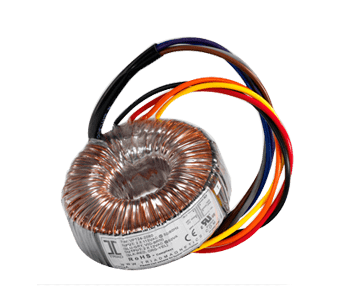
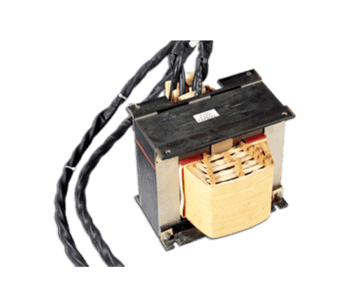
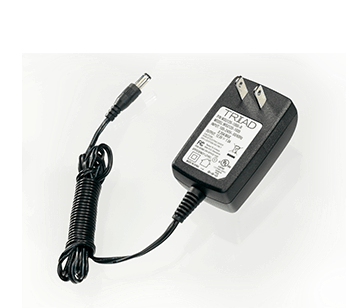
The following matrix details popular standard part numbers within our Class-2 portfolio. Design engineers can evaluate primary/secondary winding configurations, physical packaging formats, and overcurrent mechanism types for rapid engineering sampling.
| Part Number | Primary Voltage (VAC) | Secondary Voltage (RMS) | Max Current / Power | Mounting Format | Limiting Type | UL Standard |
|---|---|---|---|---|---|---|
| FD4-24 | 115 / 230V (50/60Hz) | 24.0V CT @ 0.25A | 6.0 VA | PC Board Mount | Inherently Limited | UL 5085-3 Class 2 |
| FD5-12 | 115 / 230V (50/60Hz) | 12.0V CT @ 1.00A | 12.0 VA | PC Board Mount | Inherently Limited | UL 5085-3 Class 2 |
| FD6-24 | 115 / 230V (50/60Hz) | 24.0V CT @ 1.25A | 30.0 VA | PC Board Mount | Non-Inherently Limited (TCO) | UL 5085-3 Class 2 |
| F24-500-C2 | 115V (60Hz) | 24.0V @ 0.50A | 12.0 VA | Chassis Bracket | Inherently Limited | UL 5085-3 Class 2 |
| F24-2000-C2 | 115V (60Hz) | 24.0V @ 2.08A | 50.0 VA | Chassis Channel Frame | Non-Inherently Limited (PTC) | UL 5085-3 Class 2 |
| WPT-241000 | 120V (60Hz Input) | 24.0V AC @ 1.00A | 24.0 VA | Wall Plug-In Outlet | Non-Inherently Limited | UL 1310 Listed |
As global manufacturing supply chains digitize and regulatory bodies enforce stricter efficiency standards, procurement executives face evolving challenges when sourcing magnetic components. Strategic buyers are shifting from simple piece-price considerations toward long-term total cost of ownership (TCO), material compliance, and supply chain continuity.
Energy efficiency regulations globally (such as U.S. Department of Energy (DoE) Level VI standards and European ErP Directives) are driving demanding core-loss specifications. Designers are replacing traditional low-grade grain-oriented electrical steel cores with ultra-low loss silicon steel laminations and high-permeability toroidal designs. In Class-2 transformers powering always-on Smart Building systems (such as thermostat controllers and smart lighting nodes), reducing no-load magnetizing current is essential to pass stringent standby power consumption audits.
The rapid proliferation of edge-computing IoT devices, BACnet HVAC controls, and intelligent PoE (Power over Ethernet) lighting gateways has vastly expanded the demand for 24VAC and 12VAC Class-2 transformers. Because these smart systems require clean, uninterrupted low-voltage power without risking fire hazards behind walls or in plenum spaces, UL 5085-3 Class 2 components are increasingly mandated by municipal electrical inspectors for commercial automation projects.
Geopolitical volatility and shipping bottlenecks have made single-region sourcing a high-risk strategy for global OEMs. Procurement directors are actively requiring magnetics suppliers to provide dual-plant manufacturing redundancies. Triad Magnetics meets this critical trend by operating fully certified production facilities in Perris, California, and the Philippines—enabling seamless production shifting, mitigating tariff risks, and guaranteeing uninterrupted component lead times.
Global regulatory compliance goes far beyond electrical safety. Enterprise buyers require absolute traceability regarding materials. Class-2 power transformers must meet stringent environmental mandates, including RoHS 3 (Directive 2015/863/EU), REACH (SVHC compliance), and Section 1502 of the Dodd-Frank Act regarding Conflict-Free Minerals (3TG). Triad Magnetics maintains complete material documentation and full lab certification across our entire catalog.
 ISO 9001:2015 Certified
Global OEM Quality System
ISO 9001:2015 Certified
Global OEM Quality System
Founded in 1946 in Venice, California, Triad Magnetics has pioneered custom magnetic engineering for over 75 years. From helping power early industrial automation to pioneering modern Class-2 power transformers for medical and renewable applications, our engineering depth ensures zero-defect quality.
Our state-of-the-art testing facilities perform 100% automated electrical testing, Hi-Pot isolation testing up to 4000V RMS, and thermal endurance validation under full load conditions before any lot ships to your assembly line.
Below are authoritative technical answers to the most common queries submitted by procurement teams, systems integrators, and electrical engineers when selecting Class-2 magnetics.
UL 1310 applies to complete, self-contained direct plug-in or cord-connected Class 2 Power Units intended for connection to 120V or 240V branch circuits (e.g., external wall-adapter power supplies). UL 5085-3 (which replaced the older UL 1585 standard) applies specifically to component transformers intended to be built into OEM equipment (such as HVAC control boards, industrial machinery panels, or medical devices). Component transformers certified under UL 5085-3 are evaluated for field installation within an enclosure or direct mounting on printed circuit boards.
Yes, provided the total combined power drawn across all secondary windings does not exceed the transformer's maximum VA rating (and stays strictly within the 100 VA total limit). When designing multi-output transformers (e.g., dual 12V outputs or center-tapped 24V configurations), each secondary branch must adhere to Class 2 voltage limits (≤ 30 VAC rms). If individual outputs feed separate field wiring circuits, each output circuit must maintain individual current limiting to preserve Class 2 circuit status under NEC Article 725.
The core safety philosophy of a Class-2 transformer is energy limitation. Because the transformer cannot deliver more than 100 VA under any load or short-circuit condition (either due to inherent high winding impedance or internal thermal fuses), the connected secondary wires cannot reach temperatures hot enough to ignite surrounding construction materials. As a result, electrical codes allow smaller gauge wiring (e.g., 18 AWG to 22 AWG) without requiring secondary fuses or circuit breakers in field installations.
Standard Class-2 transformers are typically rated for operation in ambient temperatures up to 40°C or 50°C. If your OEM equipment operates in elevated industrial environments (e.g., inside sealed NEMA enclosures or near boiler units reaching 70°C+), thermal derating must be applied. Operating near maximum thermal limits degrades bobbin insulation over time. Triad Magnetics offers Class F (155°C) and Class H (180°C) high-temperature insulation systems to prevent premature thermal cutoff tripping in harsh thermal environments.
In a non-inherently limited transformer equipped with a single-shot Thermal Cutoff (TCO) fuse, a sustained short circuit causes primary winding temperatures to rise rapidly until the TCO threshold (typically 130°C to 150°C) is breached. The internal TCO permanently opens the primary circuit, safely disconnecting power before insulation melts or smoke occurs. The transformer must then be replaced. For designs requiring continuous operation post-fault, Triad supplies non-inherently limited transformers equipped with self-resetting Positive Temperature Coefficient (PTC) devices or external manual-reset breakers.
Our dedicated U.S. engineering design team in Perris, California, provides rapid prototype turnaround—typically delivering fully tested sample transformers within 2 to 3 weeks following schematic and mechanical drawing approval. Once validated, production can scale seamlessly at our California facility or our high-volume ISO 9001 certified plant in the Philippines depending on your target cost and timeline requirements.
Selecting the right magnetics partner is more than just choosing a part from a catalog—it is about securing engineering expertise, regulatory certainty, and supply chain longevity. For over seven decades, Triad Magnetics has remained an industry leader by delivering unmatched enterprise capabilities:

Custom primary voltage taps (100V, 115V, 208V, 230V, 277V, 480V), dual secondary outputs, special pin layouts, split-bobbin isolation barriers, and custom mounting brackets tailored to your exact enclosure constraints.
Pre-approved UL Class B (130°C), Class F (155°C), and Class H (180°C) insulation systems allow OEMs to bypass lengthy system-level safety re-certification, accelerating time-to-market.

Over 5,000 standard magnetics part numbers stocked in major distribution networks worldwide (Digi-Key, Mouser, Allied, Arrow) combined with high-volume OEM factory direct shipments.
Connect directly with our application design engineers in Perris, California. We will analyze your schematic, recommend ideal standard components, or engineer a custom Class-2 power transformer built to your exact specifications.