Discover expert articles, design guides, and technical solutions for magnetic components, power electronics, and custom transformer applications.
Choosing the best supplier of Wall Plug-In Power Supplies in China takes more than comparing prices. A reliable partner should explain product specifications clearly, provide traceable test documentation, and answer practical engineering questions. Small details matter: output voltage and current, plug type, cable length, enclosure temperature, and performance under your actual load. Ask for a sample before approving a large order. Then check its labeling, dimensions, connector fit, and operating temperature in your own application.
Look beyond polished catalogs. Request current quality certificates and test reports, and confirm that they match the factory, product model, and destination market. Ask how incoming components are inspected and how production batches are tracked. A capable supplier should describe these steps without making vague promises. Response time matters, too. So does consistency.
There is no single supplier that suits every buyer. A compact adapter for a retail device may need different testing and packaging from a power supply used in industrial equipment. Compare lead times, minimum order quantities, customization options, warranty terms, and communication across several candidates. If answers conflict, pause and ask for clarification. That hesitation can save time later. I would not treat the lowest quote as proof of value; hidden differences in components or testing may affect reliability. The sections ahead outline practical ways to assess Chinese manufacturers and make a more informed shortlist.
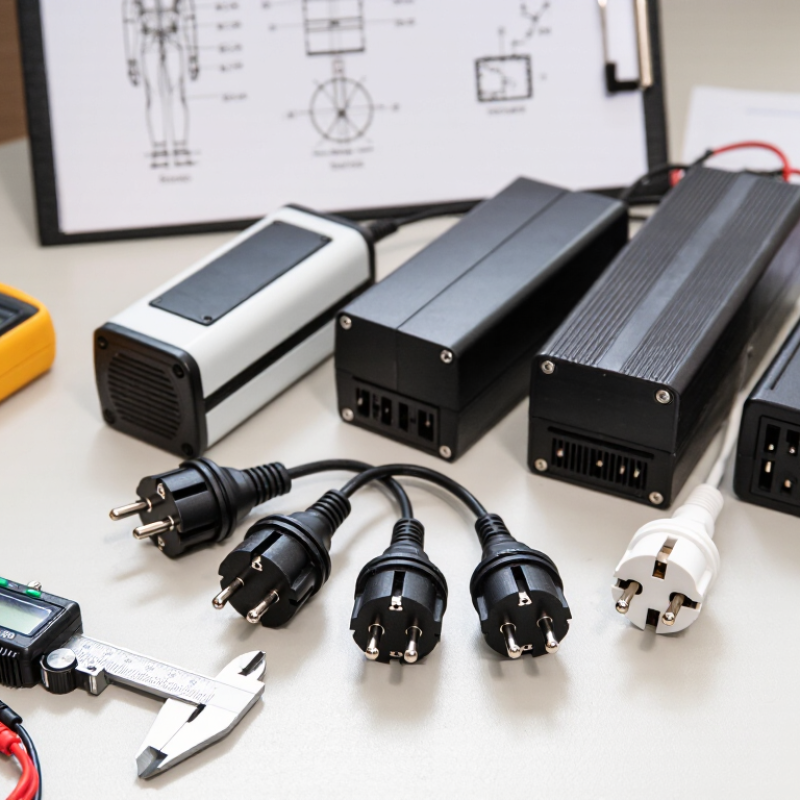
A wall plug-in power supply is a compact unit that connects directly to a wall outlet and delivers power to an electronic device. Many convert household AC electricity into lower-voltage DC, though some provide AC output. Inside, conversion and regulation components help produce power the device can use. Not every adapter has the same output.
Small, but important.
Check the label for input voltage, output voltage, current, and polarity. These details must match the device’s requirements. For example, an adapter rated at 12 volts should not be substituted for a 9-volt unit unless the device maker permits it. The connector must also fit securely; a loose plug can interrupt power. Heat matters, too. A warm enclosure may be normal, but excessive heat deserves attention.
When comparing a wall plug-in power supply supplier in China, ask for clear specifications and traceable test records. Confirm the rated output under load, cable details, and available safety protections. Samples can reveal practical issues that a datasheet misses, such as a stiff cable or awkward plug orientation. Even experienced buyers can overlook those details. A careful comparison takes time, and one specification sheet rarely tells the whole story.
Wall plug-in power supplies convert household AC power into low-voltage DC for routers, lamps, chargers, and control devices. Common types include fixed-voltage adapters, interchangeable-plug models, USB-A or USB-C supplies, and multi-output units. Choose by application: a router may need a steady 12 V output, while a USB-C device may require negotiated power delivery. The plug must fit securely, not merely look close.
Check input range, output voltage, maximum current, wattage, connector size, and polarity. Also review isolation, ripple, operating temperature, and efficiency data.
USB-IF’s USB Power Delivery 3.1 specification supports power levels up to 240 W, but only compatible equipment can use that capacity. More power is not automatically better. An oversized supply can add cost and heat without improving performance.
DOE’s external-power-supply efficiency framework also assesses active-mode efficiency and no-load consumption; compare test conditions, not just headline figures.
Tips: Match voltage exactly, then confirm polarity and connector dimensions. Leave room around the adapter for airflow. A tidy label helps, but verify specifications against the device manual before ordering.
Choosing a wall plug-in power supply supplier in China takes more than comparing quotations. Ask for the factory’s quality procedures, production capacity, and traceability records for key components. Then check whether its test plan covers input-voltage range, full-load temperature, short-circuit protection, and plug retention. Details matter. A loose plug or hot casing can reveal problems that a polished specification sheet will not.
Use independent benchmarks when reviewing performance claims. The U.S. Department of Energy’s External Power Supplies Technical Support Document describes Level VI requirements, including a 0.1-watt no-load limit for supplies rated at 49 watts or less. Ask suppliers to provide test reports showing the exact model, test conditions, and measured results. Verify that the tested sample matches the production design. A sample passing once is not enough. Repeat checks across batches, and inspect how corrective actions are recorded. This step is easy to skip when deadlines tighten. It can also expose gaps between a supplier’s paperwork and its actual process. A third-party factory audit helps, but it cannot replace hands-on sample testing.
| Evaluation Dimension | What to Check | Evidence to Request | Practical Evaluation Guidance | Suggested Weight |
|---|---|---|---|---|
| Product and electrical specifications | Output voltage and current, rated power, connector type and polarity, input range, frequency, and operating limits. | Model-specific datasheet, product label artwork, and signed specification sheet. | Confirm that input and output ratings match the intended application. A 100–240 V AC, 50/60 Hz input is common for universal-input adapters, but verify the exact model documentation. | 15% |
| Safety and destination-market compliance | Electrical safety, insulation, creepage and clearance, protective measures, and applicable market approvals. | Current certificates and test reports that identify the exact model or product family, plus the issuing laboratory and applicable standard editions. | Check requirements for the destination country and product category. IEC 62368-1 is used for many audio/video and information-technology power products; required national approvals vary by market. | 15% |
| Energy efficiency and standby power | Efficiency at specified load points and no-load power consumption. | Test report showing test conditions, input voltage, load points, and measured results. | Compare results against the efficiency rules applicable to the destination market and the exact adapter type. Do not rely on an efficiency level or logo without model-specific supporting evidence. | 10% |
| Electrical performance | Output regulation, ripple and noise, transient response, startup behavior, and protection functions. | Datasheet limits and test results with stated measurement method, bandwidth, load, and input conditions. | Compare measured performance with the requirements of the powered device. Verify over-current, over-voltage, short-circuit, and over-temperature protection where specified. | 10% |
| Plug format and mechanical fit | Fixed plug configuration, pin dimensions, housing size, outlet clearance, cable length, and connector fit. | Dimensioned drawings, plug-type details, and physical samples for the required market. | Confirm the plug standard and mechanical compatibility for each sales region. Check that the adapter does not obstruct adjacent outlets and that the connector matches the device. | 8% |
| Quality management and production controls | Incoming inspection, process controls, calibration, traceability, and handling of nonconforming products. | Quality-system certificate where applicable, inspection procedures, process records, and sample traceability documentation. | Verify that certificates are valid and cover the relevant manufacturing site. Review how production lots are identified and how corrective actions are recorded. | 10% |
| Reliability and environmental testing | Temperature performance, humidity, endurance, plug and cable durability, and other tests relevant to the intended use. | Model-specific reliability plan, test reports, sample size, acceptance criteria, and failure records. | Assess whether test conditions reflect the product’s operating environment. Treat a test claim as meaningful only when the method and acceptance criteria are documented. | 8% |
| Component and material control | Approved component list, critical-component changes, material compliance, and supply-chain traceability. | Bill of materials or controlled component list, change-control procedure, and applicable material declarations. | Ask how substitutions are reviewed and approved. Confirm that any material declarations align with the destination market’s requirements and the ordered configuration. | 7% |
| Customization and engineering support | Ability to support output variants, connector options, labeling, packaging, and technical clarification. | Written scope of customization, sample approval process, change records, and assigned technical contact. | Agree on drawings and specifications before production. Ensure changes to electrical design, components, or construction trigger a compliance review when needed. | 5% |
| Commercial terms and delivery planning | Quotation clarity, minimum order quantity, sample lead time, production lead time, payment terms, and shipping terms. | Itemized quotation, agreed lead-time schedule, packaging details, and written order terms. | Compare quotations using the same specification, packaging, testing, and delivery assumptions. Confirm how schedule changes and expedited orders are handled. | 7% |
| After-sales and corrective action | Warranty terms, complaint response, failure analysis, replacement policy, and corrective-action process. | Written warranty policy, escalation process, sample failure-analysis report, and documented corrective-action workflow. | Agree on response times, return procedures, and responsibilities before placing an order. Evaluate whether issues can be traced to the affected production lot. | 5% |
| Total Suggested Evaluation Weight | 100% | |||
A reliable wall-plug power-supply supplier should show how standards are applied on the production line, not just display certificates. Ask for the certificate scope, model list, and recent test reports. IEC 62368-1 covers safety requirements for audio/video and information technology equipment, including many power supplies. The U.S. Department of Energy’s Level VI requirements limit no-load consumption to 0.1 W for many single-voltage AC-DC adapters rated at 49 W or less; the applicable product class still matters. Check that test results match the exact output rating and plug configuration you plan to buy.
Quality control should follow each unit from incoming components to final inspection. Look for documented checks on transformer insulation, solder joints, output voltage, ripple, temperature rise, and protection against short circuits. Ask whether production staff record failures by batch and verify corrective actions. A neat audit report is useful, but it cannot prove every shipment is consistent. Even experienced factories can miss a weak solder joint. Request sample units from a normal production run, then compare labels, electrical readings, and packaging against approved specifications.
Tips: Ask for calibration records and a recent batch test sheet. Confirm that the factory can trace a finished unit back to its components and inspection date. If a supplier avoids sharing test methods, pause. Some documentation may be incomplete; clarify gaps before approving production.
Best Wall Plug In Power Supplies Supplier in China?
How to Compare Chinese Suppliers for Your Application
Compare suppliers against your actual load, not just the wattage printed on a sample. Check input range, output voltage, connector fit, cable length, and operating temperature. Ask for test data at low, typical, and full load. For a device used near a warm wall, request temperature-rise results after several hours. ENERGY STAR’s external power supply criteria set no-load limits as low as 0.1 W for certain low-power models. This is a useful benchmark, though it does not prove a supplier’s production consistency.
Tips: Request samples from the same production line planned for your order. Measure output under load, inspect the plug and cable, and verify the test report matches the exact model. Small details matter.
For safety documentation, ask which edition of IEC 62368-1 the product was evaluated against, and confirm the report covers the same enclosure and components. Compare warranty terms, traceability, minimum order quantities, and change-control procedures. A low quote can hide costly retesting if a component changes. Factory photos help, but they are not an audit. I would also ask how rejected units are recorded. Suppliers may answer that imperfectly; follow-up questions often reveal more than a polished brochure.
It connects to a wall outlet and provides power for an electronic device. Many convert household AC power into lower-voltage DC. Small, but important.
Check input range, output voltage, maximum current, wattage, connector size, and polarity. Compare every detail with the device manual. A close-looking plug may still be wrong.
Match the required voltage unless the device maker explicitly allows another value. A 12-volt adapter is not a safe substitute for a 9-volt one by default.
A supply’s current rating describes its available capacity, but voltage and polarity must still match. More capacity is not automatically useful. Check the device requirements.
Common options include fixed-voltage adapters, interchangeable-plug models, USB supplies, and multi-output units. Some USB devices negotiate their power needs. Check compatibility, not just the connector shape.
Ask for traceable component records and test reports for the exact model. Review full-load temperature, short-circuit protection, and plug-retention checks. Paperwork alone is not proof.
Try the plug in the intended outlet and device. Check whether it feels secure, whether the cable bends comfortably, and whether the adapter blocks nearby sockets. Small details matter.
Some warmth can be normal during operation, but excessive heat deserves attention. Leave space around the casing for airflow. I might still miss a problem during a brief test.
Wall Plug-In Power Supplies convert AC power from a standard outlet into the regulated DC or AC power required by electronic devices. They come in different configurations, including fixed or interchangeable plugs, single- or multi-output models, and a range of voltage, current, wattage, and connector options. Choosing the right unit means matching its electrical specifications and physical design to the application, while also considering efficiency, temperature range, protection features, and expected operating conditions.
When evaluating suppliers in China, assess their manufacturing experience, engineering support, production capacity, communication, and ability to provide consistent product quality. Review relevant safety and electromagnetic compatibility certifications, along with documented quality-control procedures such as component inspection, in-process checks, and final testing. Compare suppliers using the same technical requirements, sample results, lead times, customization options, and pricing assumptions. A structured comparison helps identify a dependable source whose products meet the application’s needs and whose quality and delivery performance can be verified.